
If you live anywhere around the McDonough Square, off Jonesboro Road, out near Eagle’s Landing, or along Highway 81, you already know how a Middle Georgia thunderstorm can roll in fast. Quiet afternoon, then a wall of rain sideways against the windows, wind bending the pines, and a few minutes of something on the roof that sounded a lot harder than rain.
By the next morning the sky is clear and life goes back to normal. The problem is that roofs do not always show what happened the night before. A lot of the damage we get called out for as a McDonough roofing company does not look like damage at all from the ground. It looks like a dry, normal roof that will surprise a homeowner with a leaking ceiling in July.
So here is a practical, local, step-by-step of what to do on your McDonough GA home after one of these spring storms passes through. No scare tactics, no pressure. Just what we actually tell our own neighbors.
What’s actually happening in McDonough’s spring storm season
Henry County sits in one of the busier thunderstorm corridors in the Southeast. From March through June, the jet stream is still active enough to pull cold air down from the north while the Gulf sends up warm, wet air. Those two meeting over Middle Georgia is the textbook setup for strong thunderstorms, which is why the NOAA Storm Prediction Center so often has our slice of the map under an outlook during these months.
The three things that hit McDonough roofs hardest this time of year are straight-line winds in the 45 to 70 mph range, small hail (usually pea to dime size, occasionally quarter or larger), and the volume of rain that comes down in ten or fifteen minutes. Each one leaves a different fingerprint on your roof, and knowing which one you got helps a roofer in McDonough figure out where to look first.
How storm damage actually shows up on a McDonough home
Wind damage tends to be spotty. A single course of shingles will look slightly lifted along the roof edge, or the ridge cap will be cocked a little. Sometimes the only tell is a crease line across a shingle where it flipped back and folded. Those shingles are usually still there, but their seal strip is broken and they will leak the next time rain pushes under them.
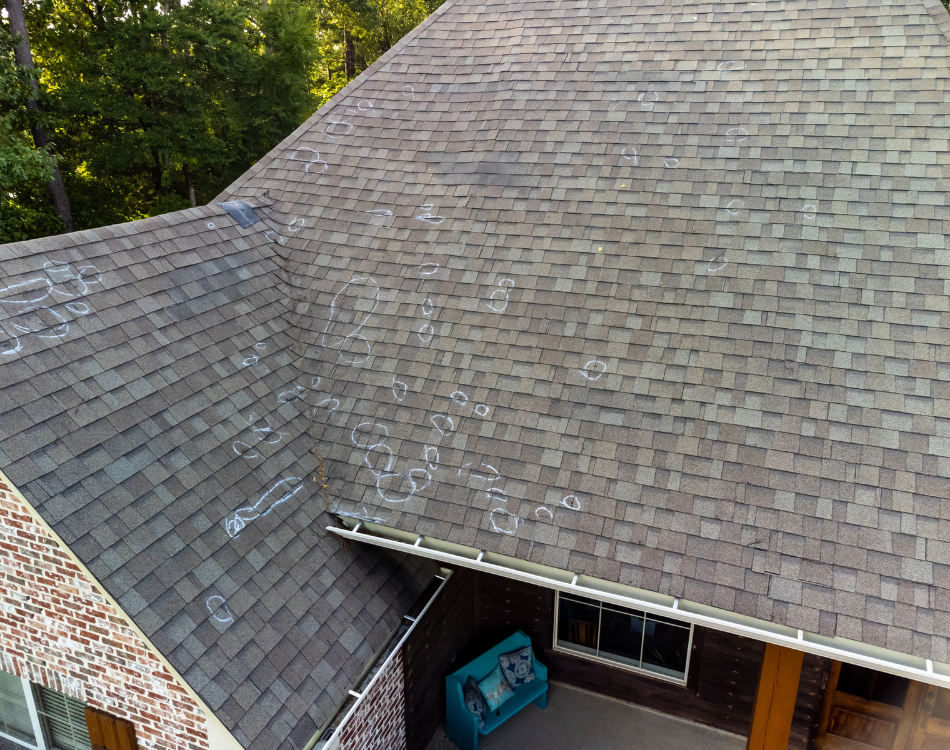
Hail damage is subtler. On an asphalt roof, a hail strike knocks the protective granules off and exposes a black or dark gray spot of mat. The bruise feels soft if you press it with your thumb. From the ground, a freshly hail-hit roof looks almost speckled. Soft metal on the home (gutters, downspouts, vents, flashing) will show small round dents on the windward side. If you have dents on your gutters, odds are high the roof took hits too. That is where a specialist like a roofer in McDonough who handles storm damage repair becomes useful, because insurance adjusters in Henry County are getting picky about what they call damage and what they call “normal wear.”

Heavy rain is its own animal. McDonough subdivisions built in the 2000s and 2010s tend to have big roof areas dumping into narrow valleys and single downspouts. When three inches of rain falls in twenty minutes, gutters overflow, fascia soaks, and water can wick back up under the drip edge. We see this a lot on Heritage Park-era homes and out around Eagle’s Landing.
What this means for your McDonough home
The window matters. In Georgia, you typically have one year from the date of loss to file a storm damage claim with most insurers, and some policies now have shorter windows for wind and hail specifically. Waiting until the ceiling stain shows up is almost always too late, because by then the insurer can argue the leak is a maintenance issue, not storm-related.
It also matters for the roof itself. A shingle with a broken seal strip does not leak immediately. It waits for the right angle of wind and rain, which in Middle Georgia could be a June pop-up thunderstorm, a July afternoon downpour, or the edge of a tropical system in September. The longer those compromised shingles sit, the more chance water has to get to the decking and the interior.
One local note. The soil in parts of Henry County holds water stubbornly. If your gutters dumped onto the ground during a storm instead of through a downspout and away from the foundation, you probably also have a water problem at your slab or crawl, not only on the roof. That is why a good post-storm check on a McDonough GA home includes a look at the gutter system, not just the shingles.
What to do about it after a spring storm
Here is the short list we give friends and customers around McDonough, Stockbridge, and Hampton when a real storm comes through.
- Walk the yard first. If you find shingle granules in piles at the bottom of downspouts, or a full shingle or piece of flashing on the ground, you already know the roof was touched. Take a photo with your phone and note the date.
- Check the soft metals at eye level. Walk slowly around the house and look at the gutters, downspouts, AC fins, gable vents, and any metal drip edge. Round dents or crimps are a hail signature. Photograph a few from different angles.
- Step back and look at the roof from the street. You are looking for lifted shingles, a course that suddenly looks darker (granule loss), ridge cap that no longer sits flat, or anything leaning that used to be straight. Do not climb up. Wet asphalt after a storm is one of the easiest ways to fall off a roof.
- Get a free inspection scheduled before 30 days pass. Most reputable storm damage crews, ours included, will document damage for your insurer at no cost. The storm damage archive has more on what adjusters look for, and our main storm damage repair page walks through the claim timeline.
If you already see water on a ceiling or a wall, treat it as urgent. Put a bucket down, move anything valuable, and call. Interior damage from a compromised roof grows fast in Georgia humidity, and drywall that dries and re-wets two or three times will start to grow mold that a simple roof repair will not solve.
Why Crest for McDonough roofing and gutter work
We have been a McDonough roofing company for twelve years now, based just down I-75 in Jackson GA at our shop on Meadowview Drive. That means we are in Henry County most days of the week and can usually be at a McDonough address within a few hours of a storm call, not a few days. Being small and local also means the same crew that inspects your roof is the one doing the repair, and the same person (Chad) signs off on the work.
Beyond storm damage, we handle shingle roof replacement in McDonough, standing seam metal roofing, and seamless gutter installs. The Crest team carries Georgia licensing, full liability insurance, and we back every install with a 10-year workmanship warranty. Five-star rated on Google, 100 percent customer satisfaction to date, and we are happy to share references from neighbors right around the McDonough Square or off Highway 81.
Frequently Asked Questions About Storm Damage Repair in McDonough GA
How soon after a storm should I have my McDonough roof inspected?
Within 30 days is a good rule. Sooner is better if you saw hail, heard loud impacts during the storm, or already have shingle granules piled at your downspouts. Most insurers prefer a dated inspection report tied close to the event.
Will a post-storm inspection hurt my homeowner’s insurance?
No. A free inspection by a licensed roofer is not a claim. We document what we find and you decide whether to file. If there is no storm damage, we tell you that, and nothing gets reported to your carrier.
What if my roof looks fine from the ground?
A McDonough roof can pass the curb test and still have hail bruises or broken seal strips that only show up on the roof itself. This is especially true with small hail (dime to quarter size). An on-roof inspection is the only way to know for sure.
Do you work with my insurance company for storm damage claims?
Yes. We meet adjusters on site, walk the roof with them, and document any damage they miss. We do not handle the actual paperwork for you, but we make sure the adjuster sees what is there. Most McDonough homeowners find that helpful.
How much does storm damage repair cost in McDonough GA?
It depends on the scope, but minor shingle and flashing repairs typically run a few hundred dollars, while a full storm-driven replacement is comparable to a normal replacement and in most cases is covered (minus deductible) by homeowners insurance. We give written estimates before any work starts.
Serving McDonough and the Rest of Henry County
Our crews work every corner of Henry County, from the McDonough Square to Stockbridge, Hampton, and Locust Grove, along with the surrounding Butts, Spalding, and Lamar counties. If you are in McDonough GA 30253 and a storm just came through, we are probably closer than you think. Picking a roofer McDonough homeowners actually trust is half the battle after a storm, and we earn that trust one conversation at a time.
To schedule a free post-storm roof and gutter inspection on your McDonough home, call Crest Roofing and Gutters at (478) 375-6175 or visit the home page for service details. No pressure and no obligation. Just a straight answer from a local roofer about what your roof needs.
About the author. Chad is the owner of Crest Roofing and Gutters, a locally owned, licensed, and insured Georgia roofing contractor based in Jackson GA with twelve years in the industry. He personally inspects McDonough area storm damage claims, runs the install crews, and stands behind every job with a 10-year workmanship warranty and a free, no-pressure inspection.